
Xiaomi Motors: Over 1.26 million charging piles now integrated into the Xiaomi Charging Map
2025-05-09
Xiaomi Motors: Over 1.26 million charging piles now integrated into the Xiaomi Charging Map
On April 28, Xiaomi Auto announced that its charging network continues to expand. As of now, it has partnered with 18 leading operators in the industry to build a comprehensive charging and energy-supply network, featuring more than 1.26 million charging piles integrated into the Xiaomi Charging Map. This coverage spans across 2,691 counties and districts in mainland China. Among them, there are 94,000 supercharging stations and 970,000 DC fast-charging stations, along with 6,221 charging stations located in service areas.
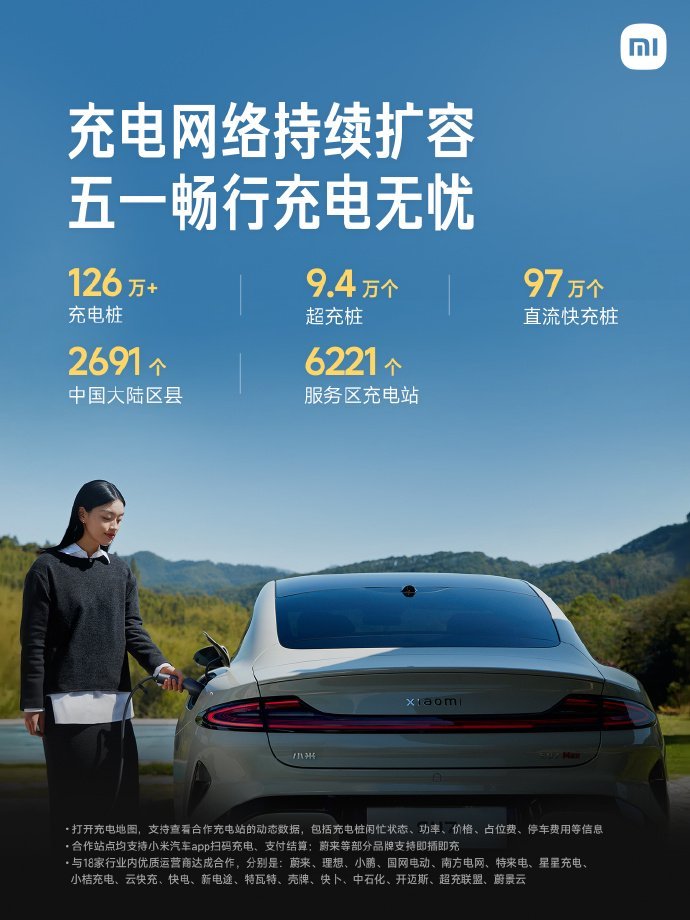
Previously, on January 26 of this year, Xiaomi Auto announced that it had partnered with 13 leading operators in the industry to build a charging and energy-supply network, resulting in more than 1.02 million charging piles being integrated into the Xiaomi Charging Map. In addition to these partnerships for charging infrastructure, Xiaomi Auto also launched collaborative efforts with NIO, XPeng, and Li Auto in December 2024. This latest collaboration means that over 14,000 NIO charging stations, more than 9,000 XPeng charging stations, and over 6,000 Li Auto charging stations have been added to the Xiaomi Charging Map, enabling users to view real-time data directly through the map. However, there are still slight differences in the benefits offered by each brand: while Li Auto provides full support for scanning QR codes via the Xiaomi Auto app at select charging stations, XPeng charging stations already offer a convenient "plug-and-charge" service.
In terms of building its own charging network, Xiaomi Auto has indeed made initial arrangements but hasn’t yet rolled out the initiative on a large scale. Back in March 2024, Lei Jun announced at Xiaomi Auto’s launch event that the company was actively developing its own supercharging network, starting with pilot projects in cities like Beijing, Shanghai, and Hangzhou, and initially deploying a cutting-edge 600kW liquid-cooled ultra-fast charging solution. However, by August of the same year, Lei Jun revealed that although Xiaomi had already set up a few charging stations, there were no immediate plans for extensive nationwide expansion. Currently, China already boasts an ample number of public charging piles, and Xiaomi has been diligently testing these facilities—having evaluated over 70,000 public charging points—and identified hundreds of areas needing improvement. At the time, Lei Jun emphasized that Xiaomi’s top priority remains focused on vehicle manufacturing, with the ultimate goal of making the Xiaomi SU7 (specifications | price inquiry) the electric car that offers the best compatibility and convenience when paired with existing public charging infrastructure. Beyond public charging stations, Xiaomi has also introduced a convenient home-charging solution, boasting features like "one-click lid opening, plug-and-charge simplicity," along with seamless OTA software updates. Meanwhile, according to publicly available data, Xiaomi delivered more than 29,000 SU7 units in March alone. Xiaomi Auto confidently stated: "Our current production capacity is ramping up smoothly, and we remain fully committed to achieving our annual delivery target of 350,000 vehicles."
Translated from Sina Auto
Previous post:
Xiaomi Motors: Over 1.26 million charging piles now integrated into the Xiaomi Charging Map
2025-05-09
Xiaomi Motors: Over 1.26 million charging piles now integrated into the Xiaomi Charging Map
On April 28, Xiaomi Auto announced that its charging network continues to expand. As of now, it has partnered with 18 leading operators in the industry to build a comprehensive charging and energy-supply network, featuring more than 1.26 million charging piles integrated into the Xiaomi Charging Map. This coverage spans across 2,691 counties and districts in mainland China. Among them, there are 94,000 supercharging stations and 970,000 DC fast-charging stations, along with 6,221 charging stations located in service areas.
Previously, on January 26 of this year, Xiaomi Auto announced that it had partnered with 13 leading operators in the industry to build a charging and energy-supply network, resulting in more than 1.02 million charging piles being integrated into the Xiaomi Charging Map. In addition to these partnerships for charging infrastructure, Xiaomi Auto also launched collaborative efforts with NIO, XPeng, and Li Auto in December 2024. This latest collaboration means that over 14,000 NIO charging stations, more than 9,000 XPeng charging stations, and over 6,000 Li Auto charging stations have been added to the Xiaomi Charging Map, enabling users to view real-time data directly through the map. However, there are still slight differences in the benefits offered by each brand: while Li Auto provides full support for scanning QR codes via the Xiaomi Auto app at select charging stations, XPeng charging stations already offer a convenient "plug-and-charge" service.
In terms of building its own charging network, Xiaomi Auto has indeed made initial arrangements but hasn’t yet rolled out the initiative on a large scale. Back in March 2024, Lei Jun announced at Xiaomi Auto’s launch event that the company was actively developing its own supercharging network, starting with pilot projects in cities like Beijing, Shanghai, and Hangzhou, and initially deploying a cutting-edge 600kW liquid-cooled ultra-fast charging solution. However, by August of the same year, Lei Jun revealed that although Xiaomi had already set up a few charging stations, there were no immediate plans for extensive nationwide expansion. Currently, China already boasts an ample number of public charging piles, and Xiaomi has been diligently testing these facilities—having evaluated over 70,000 public charging points—and identified hundreds of areas needing improvement. At the time, Lei Jun emphasized that Xiaomi’s top priority remains focused on vehicle manufacturing, with the ultimate goal of making the Xiaomi SU7 (specifications | price inquiry) the electric car that offers the best compatibility and convenience when paired with existing public charging infrastructure. Beyond public charging stations, Xiaomi has also introduced a convenient home-charging solution, boasting features like "one-click lid opening, plug-and-charge simplicity," along with seamless OTA software updates. Meanwhile, according to publicly available data, Xiaomi delivered more than 29,000 SU7 units in March alone. Xiaomi Auto confidently stated: "Our current production capacity is ramping up smoothly, and we remain fully committed to achieving our annual delivery target of 350,000 vehicles."
Translated from Sina Auto
Previous post:

Contact us
Email:
info@adtfm.com
Phone:
021-20532053
Address:
2nd Floor, No. 150 Jindian Road, Pudong New Area, Shanghai

Phone:021-50790270
Email:info@adtfm.com
Website:www.adtfm.com
Address: Room 403, Building B, No. 115 Guiqiao Road, Pudong New Area, Shanghai


Leave a message for inquiry