
New players deliver their results as auto market accelerates reshuffling.
2025-01-03
New players deliver—automotive market accelerates reshuffling
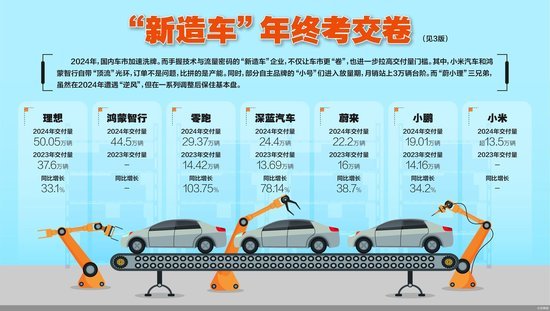
In 2024, China's auto market is accelerating its reshuffling. While previously the competition mainly involved traditional automakers rearranging their positions, the entry of numerous "new EV makers" has now pushed the industry into a fierce battle for survival—essentially a last-man-standing scenario. Meanwhile, these "new EV companies," armed with cutting-edge technology and powerful user engagement strategies, are not only intensifying the competitive pressure in the market but also raising the bar for delivery volumes even higher. Among them, Xiaomi Auto and Hongmeng Zhixing naturally carry the aura of being "top-tier" brands; securing orders isn’t their biggest challenge—they’re now competing primarily on production capacity. At the same time, several domestic automakers’ smaller-scale brands are entering a phase of rapid scaling, with monthly sales already surpassing the 30,000-vehicle mark. As for the "Weilai Xiaoli" trio, despite facing headwinds in 2024, they’ve managed to hold onto their core market position after implementing a series of strategic adjustments.
On the eve of the New Year, Lei Jun, founder, chairman, and CEO of Xiaomi Group, swiftly released Xiaomi Auto’s full-year performance report, boldly setting a new target of delivering 300,000 vehicles by 2025. In April 2024, Xiaomi Auto officially kicked off deliveries of its first model, the SU7. From its market launch to its delivery phase, the SU7 has maintained soaring popularity throughout the year. By November, Lei Jun announced that deliveries of the Xiaomi SU7 had already surpassed 100,000 units—already beating the company’s original annual goal—and now Xiaomi Auto is aiming even higher, striving to deliver 130,000 vehicles this year. Since Xiaomi entered the automotive arena, names like “Lei Jun,” “Xiaomi,” and the SU7 have become synonymous with massive online traffic and consumer interest. Meanwhile, the steadily growing number of orders for the Xiaomi SU7 has underscored for many automakers the critical link between digital engagement and actual sales. As a result, in 2024, numerous car company executives jumped into livestreaming platforms, embracing the live-commerce trend as a strategic move to boost both brand visibility and vehicle sales.
However, even though Xiaomi Auto has already achieved monetization of its traffic, Lei Jun believes that hitting the annual sales target of 300,000 vehicles will still be a significant challenge. To meet this goal, Xiaomi Auto plans to continue expanding its production capacity in 2025, ensuring timely deliveries. At the same time, the company will also accelerate its channel expansion strategy. A Xiaomi Auto representative stated that the brand added 50 new stores in December 2024. In January 2025, Xiaomi Auto aims to open an additional 16 stores, expected to bring coverage to six more cities, including Hohhot and Luoyang. Meanwhile, Xiaomi's second model, the Xiaomi YU7, is also set to launch in 2025. Meanwhile, Hongmeng Zhixing, another player deeply entrenched in the traffic-driven automotive market, delivered over 440,000 vehicles in 2024—a remarkable achievement that saw nearly 50,000 units delivered in December alone, marking a new monthly sales record for the brand. In 2024, Hongmeng Zhixing successfully completed its "four-domain" lineup, with models from the AITO, Enjoy, and ZhiJie series all entering the delivery phase. Notably, in 2024, Hongmeng Zhixing introduced its third "domain" model—Enjoy S9 (available for configuration and pricing inquiry)—filling a critical gap in the high-end, executive-class luxury sedan segment. According to data, the Enjoy S9 series delivered 7,494 units throughout 2024, cementing its position as the best-selling pure-electric luxury sedan priced above 400,000 yuan for five consecutive months.
However, in terms of sales share, AITO remains a major player, with the AITO M7 delivering over 190,000 units in 2024. Meanwhile, the AITO M9 has already surpassed 200,000 cumulative "large pre-orders" within 12 months of its launch. This means that the AITO M7 alone accounts for nearly half of Hongmeng Zhixing's total sales. AITO's impressive sales performance is also putting pressure on traditional luxury brands. According to what Beijing Business Today learned, several dealerships formerly specializing in conventional luxury vehicles have recently "switched over" to the AITO brand in 2024. One dealership manager noted that while prices for traditional fuel-powered cars at the retail level tend to fluctuate significantly, models from leading new-energy brands like AITO enjoy relatively stable pricing and high profit margins. For dealerships, maintaining both price and volume ensures healthy profitability. Meanwhile, Xiaomi and Hongmeng Zhixing are successfully monetizing their traffic, and even domestic automakers' "smaller" brands are entering a phase of rapid growth. Among them, Deepal, as Changan Group's "younger sibling," has surged into the forefront of the "new EV makers," delivering 244,000 new vehicles in 2024—a year-on-year increase of 78.14%. Notably, Deepal delivered 36,600 new cars in December alone, setting a new monthly delivery record for the fifth consecutive month. Currently, Deepal offers five models—SL03, S07, G318, L07, and S05—catering primarily to both range-extending hybrid and pure-electric powertrains. Among these, the S07 and S05 have garnered particularly strong market acceptance.
According to statistics, from the launch of Deepal Motors' first model, the SL03, in July 2022 to December 2024, Deepal Motors has already delivered 400,000 new vehicles—achieving this milestone in just 29 months. Building on its strong performance in 2024, Deepal Motors has set an ambitious target of delivering 500,000 vehicles in 2025, with 400,000 units earmarked for the domestic market and 100,000 aimed at overseas sales. Yan Jinghui, a member of the Expert Committee at the China Automobile Dealers Association, notes that Chinese automakers have significantly improved vehicle quality in recent years, making their products highly competitive on the global stage. In fact, Chinese brands have attracted a growing number of loyal customers overseas. For Deepal Motors, expanding its presence in international markets is crucial if it hopes to further boost sales volume. Meanwhile, Avatr, backed by Changan Automobile, CATL, and Huawei, delivered 73,600 new vehicles in 2024, including 11,100 units in December alone—marking the third consecutive month with sales exceeding 10,000 units. As Avatr continues to ramp up its sales momentum, the company is also actively advancing its IPO plans. Recently, Avatr announced the completion of its Series C funding round, raising over 11 billion yuan. This round was jointly led by Changan Automobile, YuFu-affiliated funds, Southern Asset Management funds, CITIC-backed funds, ICBC Investment, and other strategic and market-oriented investors. Concurrently, Avatr has already initiated preparations for its public listing, with plans to go public in 2026.
Additionally, as a premium brand under Dongfeng Motor, Voyah delivered an impressive performance in 2024. Data shows that Voyah achieved sales of 85,700 vehicles in 2024, representing a year-on-year growth of 70%. Notably, December saw sales of 12,100 units, marking the fourth consecutive month with monthly sales exceeding 10,000 vehicles. Voyah CEO Lu Fang stated: "In 2025, we aim to accelerate toward our annual sales target of 200,000 vehicles and introduce more than four all-new or revamped models." Back in 2020, He Xiaopeng, Chairman of XPeng Motors, shared a photo on social media featuring himself alongside William Li, Chairman and CEO of NIO, and Li Xiang, Chairman and CEO of Li Auto, captioning it with, "The three reminisce about hardships and contemplate change." Fast forward to 2024, however, life hasn't been easy for these "three brothers" either. According to the latest figures, Li Auto surpassed 500,000 vehicle sales in 2024, with December sales nearing 60,000 units—a 16.21% increase year-on-year. While Li Auto successfully retained its position as the top-selling new EV brand in China for the entire year, the company briefly faced headwinds during the latter half of 2024.
In fact, 2024 is set to be a landmark year for Li Auto’s product lineup. In addition to launching the MEGA model and refreshing the L “789” series, the company also introduced the Li Auto L6, which further lowers the price range, along with three all-electric models. However, at the beginning of 2024, the exterior design of the Li Auto MEGA sparked controversy and subsequently led to a series of sales setbacks. Moreover, Li Auto’s L-series vehicles have faced increasing competition from AITO’s M-series models. According to statistics, in the first quarter of 2024, AITO achieved sales of 85,800 vehicles, representing a staggering year-on-year growth of 636.27%—enough to snatch the top spot in new-energy vehicle sales from Li Auto during that period. Amidst these sales fluctuations, Li Xiang has begun reflecting on the company’s strategies. In an internal letter, Li Xiang acknowledged, "The chaotic rollout of the Li Auto MEGA resulted in our sales team significantly cutting back on the time and energy dedicated to serving L-series customers." Fortunately, after timely adjustments, Li Auto’s sales have gradually started recovering. "Currently, the Chinese automotive market is fiercely competitive, entering a new round of intense industry consolidation," noted Cui Dongshu, Secretary-General of the Passenger Car Market Information Joint Association under the China Automobile Dealers Association. "In this highly competitive environment, rivals are constantly poised to seize market share whenever they can."
For 2024, He Xiaopeng frankly described the journey as "moving forward against the wind," noting that XPeng Motors had once faced its darkest moment. Data shows that in the first half of 2024, XPeng delivered 52,000 vehicles, with just 21,800 units delivered in the first quarter alone. The remarkable turnaround for XPeng was largely driven by two new models: the MONA M03 (specifications | price inquiry) and the P7+. A company representative from XPeng Motors revealed that the MONA M03 rolled off the production line as the 50,000th vehicle only four months after its launch. Meanwhile, XPeng’s factories have ramped up production to full speed, now capable of churning out one MONA M03 every 72 seconds. Looking at the numbers, XPeng’s total sales in 2024 exceeded 190,000 vehicles, with December seeing a robust 36,700-unit delivery—up 82.43% year-on-year. By model, in December 2024, the MONA M03 accounted for over 15,000 deliveries, while the P7+ surpassed 10,000 units. As for 2025, XPeng is placing high hopes on AI technology. He Xiaopeng announced that XPeng plans to introduce several all-new models in 2025, each fully equipped with XPeng’s advanced AI system. Looking ahead, XPeng aims to refine its product lineup over the next three years, focusing on fewer, more specialized models that stand out in the competitive electric vehicle market.
Compared to the bumpy rides of Li Auto and XPeng Motors, NIO's stability in 2024 has become a double-edged sword. In July 2023, NIO’s deliveries first surpassed 20,000 units—but soon after, monthly sales dipped back into the 10,000-unit range, only rebounding again in May 2024. By that point, however, achieving 20,000 monthly sales was no longer a standout feat among China’s new EV brands. For NIO, entering an era of growth stagnation now calls for launching a new brand to bolster its "self-sustaining" capabilities. In May 2024, NIO unveiled its new brand, Ledor, and with both the NIO and Ledor brands working in tandem, the company’s overall sales soared past 30,000 units for the first time in December 2024—marking a remarkable 72.87% year-on-year growth. Ultimately, NIO delivered over 220,000 vehicles in 2024 alone. According to NIO’s strategic roadmap, the Ledor brand will introduce new models in 2025, aiming to achieve an average monthly delivery target of 20,000 units. Meanwhile, the NIO brand is expected to maintain steady growth based on 2024 levels, with both brands collectively surpassing 400,000 units for the full year. Additionally, during the 2024 NIO DAY event, NIO officially launched its third brand, Firefly, with plans to debut it in April 2025.
Translated from Sina Auto
Previous post:
New players deliver their results as auto market accelerates reshuffling.
2025-01-03
New players deliver—automotive market accelerates reshuffling
In 2024, China's auto market is accelerating its reshuffling. While previously the competition mainly involved traditional automakers rearranging their positions, the entry of numerous "new EV makers" has now pushed the industry into a fierce battle for survival—essentially a last-man-standing scenario. Meanwhile, these "new EV companies," armed with cutting-edge technology and powerful user engagement strategies, are not only intensifying the competitive pressure in the market but also raising the bar for delivery volumes even higher. Among them, Xiaomi Auto and Hongmeng Zhixing naturally carry the aura of being "top-tier" brands; securing orders isn’t their biggest challenge—they’re now competing primarily on production capacity. At the same time, several domestic automakers’ smaller-scale brands are entering a phase of rapid scaling, with monthly sales already surpassing the 30,000-vehicle mark. As for the "Weilai Xiaoli" trio, despite facing headwinds in 2024, they’ve managed to hold onto their core market position after implementing a series of strategic adjustments.
On the eve of the New Year, Lei Jun, founder, chairman, and CEO of Xiaomi Group, swiftly released Xiaomi Auto’s full-year performance report, boldly setting a new target of delivering 300,000 vehicles by 2025. In April 2024, Xiaomi Auto officially kicked off deliveries of its first model, the SU7. From its market launch to its delivery phase, the SU7 has maintained soaring popularity throughout the year. By November, Lei Jun announced that deliveries of the Xiaomi SU7 had already surpassed 100,000 units—already beating the company’s original annual goal—and now Xiaomi Auto is aiming even higher, striving to deliver 130,000 vehicles this year. Since Xiaomi entered the automotive arena, names like “Lei Jun,” “Xiaomi,” and the SU7 have become synonymous with massive online traffic and consumer interest. Meanwhile, the steadily growing number of orders for the Xiaomi SU7 has underscored for many automakers the critical link between digital engagement and actual sales. As a result, in 2024, numerous car company executives jumped into livestreaming platforms, embracing the live-commerce trend as a strategic move to boost both brand visibility and vehicle sales.
However, even though Xiaomi Auto has already achieved monetization of its traffic, Lei Jun believes that hitting the annual sales target of 300,000 vehicles will still be a significant challenge. To meet this goal, Xiaomi Auto plans to continue expanding its production capacity in 2025, ensuring timely deliveries. At the same time, the company will also accelerate its channel expansion strategy. A Xiaomi Auto representative stated that the brand added 50 new stores in December 2024. In January 2025, Xiaomi Auto aims to open an additional 16 stores, expected to bring coverage to six more cities, including Hohhot and Luoyang. Meanwhile, Xiaomi's second model, the Xiaomi YU7, is also set to launch in 2025. Meanwhile, Hongmeng Zhixing, another player deeply entrenched in the traffic-driven automotive market, delivered over 440,000 vehicles in 2024—a remarkable achievement that saw nearly 50,000 units delivered in December alone, marking a new monthly sales record for the brand. In 2024, Hongmeng Zhixing successfully completed its "four-domain" lineup, with models from the AITO, Enjoy, and ZhiJie series all entering the delivery phase. Notably, in 2024, Hongmeng Zhixing introduced its third "domain" model—Enjoy S9 (available for configuration and pricing inquiry)—filling a critical gap in the high-end, executive-class luxury sedan segment. According to data, the Enjoy S9 series delivered 7,494 units throughout 2024, cementing its position as the best-selling pure-electric luxury sedan priced above 400,000 yuan for five consecutive months.
However, in terms of sales share, AITO remains a major player, with the AITO M7 delivering over 190,000 units in 2024. Meanwhile, the AITO M9 has already surpassed 200,000 cumulative "large pre-orders" within 12 months of its launch. This means that the AITO M7 alone accounts for nearly half of Hongmeng Zhixing's total sales. AITO's impressive sales performance is also putting pressure on traditional luxury brands. According to what Beijing Business Today learned, several dealerships formerly specializing in conventional luxury vehicles have recently "switched over" to the AITO brand in 2024. One dealership manager noted that while prices for traditional fuel-powered cars at the retail level tend to fluctuate significantly, models from leading new-energy brands like AITO enjoy relatively stable pricing and high profit margins. For dealerships, maintaining both price and volume ensures healthy profitability. Meanwhile, Xiaomi and Hongmeng Zhixing are successfully monetizing their traffic, and even domestic automakers' "smaller" brands are entering a phase of rapid growth. Among them, Deepal, as Changan Group's "younger sibling," has surged into the forefront of the "new EV makers," delivering 244,000 new vehicles in 2024—a year-on-year increase of 78.14%. Notably, Deepal delivered 36,600 new cars in December alone, setting a new monthly delivery record for the fifth consecutive month. Currently, Deepal offers five models—SL03, S07, G318, L07, and S05—catering primarily to both range-extending hybrid and pure-electric powertrains. Among these, the S07 and S05 have garnered particularly strong market acceptance.
According to statistics, from the launch of Deepal Motors' first model, the SL03, in July 2022 to December 2024, Deepal Motors has already delivered 400,000 new vehicles—achieving this milestone in just 29 months. Building on its strong performance in 2024, Deepal Motors has set an ambitious target of delivering 500,000 vehicles in 2025, with 400,000 units earmarked for the domestic market and 100,000 aimed at overseas sales. Yan Jinghui, a member of the Expert Committee at the China Automobile Dealers Association, notes that Chinese automakers have significantly improved vehicle quality in recent years, making their products highly competitive on the global stage. In fact, Chinese brands have attracted a growing number of loyal customers overseas. For Deepal Motors, expanding its presence in international markets is crucial if it hopes to further boost sales volume. Meanwhile, Avatr, backed by Changan Automobile, CATL, and Huawei, delivered 73,600 new vehicles in 2024, including 11,100 units in December alone—marking the third consecutive month with sales exceeding 10,000 units. As Avatr continues to ramp up its sales momentum, the company is also actively advancing its IPO plans. Recently, Avatr announced the completion of its Series C funding round, raising over 11 billion yuan. This round was jointly led by Changan Automobile, YuFu-affiliated funds, Southern Asset Management funds, CITIC-backed funds, ICBC Investment, and other strategic and market-oriented investors. Concurrently, Avatr has already initiated preparations for its public listing, with plans to go public in 2026.
Additionally, as a premium brand under Dongfeng Motor, Voyah delivered an impressive performance in 2024. Data shows that Voyah achieved sales of 85,700 vehicles in 2024, representing a year-on-year growth of 70%. Notably, December saw sales of 12,100 units, marking the fourth consecutive month with monthly sales exceeding 10,000 vehicles. Voyah CEO Lu Fang stated: "In 2025, we aim to accelerate toward our annual sales target of 200,000 vehicles and introduce more than four all-new or revamped models." Back in 2020, He Xiaopeng, Chairman of XPeng Motors, shared a photo on social media featuring himself alongside William Li, Chairman and CEO of NIO, and Li Xiang, Chairman and CEO of Li Auto, captioning it with, "The three reminisce about hardships and contemplate change." Fast forward to 2024, however, life hasn't been easy for these "three brothers" either. According to the latest figures, Li Auto surpassed 500,000 vehicle sales in 2024, with December sales nearing 60,000 units—a 16.21% increase year-on-year. While Li Auto successfully retained its position as the top-selling new EV brand in China for the entire year, the company briefly faced headwinds during the latter half of 2024.
In fact, 2024 is set to be a landmark year for Li Auto’s product lineup. In addition to launching the MEGA model and refreshing the L “789” series, the company also introduced the Li Auto L6, which further lowers the price range, along with three all-electric models. However, at the beginning of 2024, the exterior design of the Li Auto MEGA sparked controversy and subsequently led to a series of sales setbacks. Moreover, Li Auto’s L-series vehicles have faced increasing competition from AITO’s M-series models. According to statistics, in the first quarter of 2024, AITO achieved sales of 85,800 vehicles, representing a staggering year-on-year growth of 636.27%—enough to snatch the top spot in new-energy vehicle sales from Li Auto during that period. Amidst these sales fluctuations, Li Xiang has begun reflecting on the company’s strategies. In an internal letter, Li Xiang acknowledged, "The chaotic rollout of the Li Auto MEGA resulted in our sales team significantly cutting back on the time and energy dedicated to serving L-series customers." Fortunately, after timely adjustments, Li Auto’s sales have gradually started recovering. "Currently, the Chinese automotive market is fiercely competitive, entering a new round of intense industry consolidation," noted Cui Dongshu, Secretary-General of the Passenger Car Market Information Joint Association under the China Automobile Dealers Association. "In this highly competitive environment, rivals are constantly poised to seize market share whenever they can."
For 2024, He Xiaopeng frankly described the journey as "moving forward against the wind," noting that XPeng Motors had once faced its darkest moment. Data shows that in the first half of 2024, XPeng delivered 52,000 vehicles, with just 21,800 units delivered in the first quarter alone. The remarkable turnaround for XPeng was largely driven by two new models: the MONA M03 (specifications | price inquiry) and the P7+. A company representative from XPeng Motors revealed that the MONA M03 rolled off the production line as the 50,000th vehicle only four months after its launch. Meanwhile, XPeng’s factories have ramped up production to full speed, now capable of churning out one MONA M03 every 72 seconds. Looking at the numbers, XPeng’s total sales in 2024 exceeded 190,000 vehicles, with December seeing a robust 36,700-unit delivery—up 82.43% year-on-year. By model, in December 2024, the MONA M03 accounted for over 15,000 deliveries, while the P7+ surpassed 10,000 units. As for 2025, XPeng is placing high hopes on AI technology. He Xiaopeng announced that XPeng plans to introduce several all-new models in 2025, each fully equipped with XPeng’s advanced AI system. Looking ahead, XPeng aims to refine its product lineup over the next three years, focusing on fewer, more specialized models that stand out in the competitive electric vehicle market.
Compared to the bumpy rides of Li Auto and XPeng Motors, NIO's stability in 2024 has become a double-edged sword. In July 2023, NIO’s deliveries first surpassed 20,000 units—but soon after, monthly sales dipped back into the 10,000-unit range, only rebounding again in May 2024. By that point, however, achieving 20,000 monthly sales was no longer a standout feat among China’s new EV brands. For NIO, entering an era of growth stagnation now calls for launching a new brand to bolster its "self-sustaining" capabilities. In May 2024, NIO unveiled its new brand, Ledor, and with both the NIO and Ledor brands working in tandem, the company’s overall sales soared past 30,000 units for the first time in December 2024—marking a remarkable 72.87% year-on-year growth. Ultimately, NIO delivered over 220,000 vehicles in 2024 alone. According to NIO’s strategic roadmap, the Ledor brand will introduce new models in 2025, aiming to achieve an average monthly delivery target of 20,000 units. Meanwhile, the NIO brand is expected to maintain steady growth based on 2024 levels, with both brands collectively surpassing 400,000 units for the full year. Additionally, during the 2024 NIO DAY event, NIO officially launched its third brand, Firefly, with plans to debut it in April 2025.
Translated from Sina Auto
Previous post:

Contact us
Email:
info@adtfm.com
Phone:
021-20532053
Address:
2nd Floor, No. 150 Jindian Road, Pudong New Area, Shanghai

Phone:021-50790270
Email:info@adtfm.com
Website:www.adtfm.com
Address: Room 403, Building B, No. 115 Guiqiao Road, Pudong New Area, Shanghai


Leave a message for inquiry