
Technology is the lifeblood of the project—highlighting business and technical improvements in Jirun’s Yuyao Factory Coating Project.
2020-05-22
Technology is the lifeblood of the project.
— Highlighting Business and Technical Improvements in the Jirun Yuyao Factory Coating Project
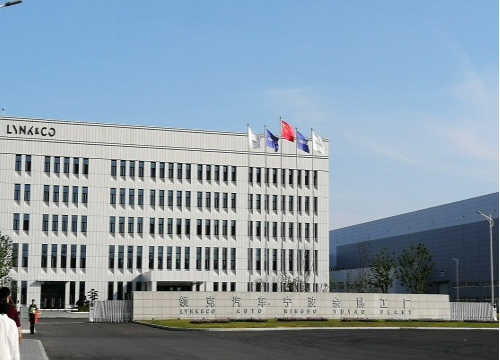
Dust is the biggest enemy of automotive paint shops. The cleanliness of the paint shop environment is a significant factor directly impacting the quality of a car's surface, and this is particularly pronounced for the paint process. Precisely because of this, controlling defects in the production environment is a crucial component of ADT on-site projects. From April 23rd to 27th, 2020, Lin Liyan, Technical Manager of Paint Defect Analysis in the company's Technology Development Department, visited the Jirun Yuyao plant's paint project to provide technical guidance and training to the project team. She also helped the client resolve the difficulty of controlling dust particles in the paint mix room.
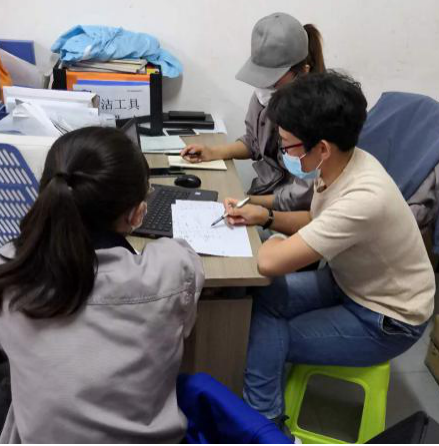
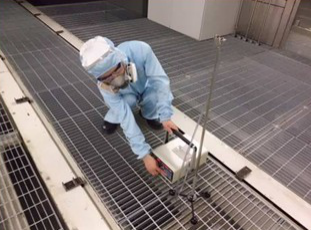
The four-day training covered process control methods, environmental standards, and maintenance improvement measures. Within the production process, the training focused on applying process control methods to actual operations. Based on workshop processes and on-the-job experience, the training specifically outlined the sources, transmission methods, and control methods for defects. The importance of process control is specifically demonstrated in this regard: the role of paint defect analysts in the paint shop is to assist customers in improving product quality. If defects are introduced during the production process, good process control can play a crucial role in preventing them from propagating, ultimately significantly improving the quality of finished vehicles and reducing associated repair costs. Air Cleanliness Training: Based on the on-site air conditioning system and air filtration media usage, in conjunction with ISO14644-1 cleanroom and related controlled environment international standards, professional training is provided on on-site air cleanliness classification, usage standards, particle counter usage and precautions, data interpretation, common problems during use, and data analysis. For example, training focuses on factors affecting air cleanliness test results, such as wind balance, the impact of personnel movement, the influence of spray paint mist, and the differences in data tested under static, empty, and dynamic conditions. When test data exceeds control indicators, the reasons for the excess are analyzed from the five aspects of human, machine, material, method, and environment. The paint mixing room is the heart of the paint shop and is a Class 1 high-cleanliness area within the paint shop. Particle control in this area was a major challenge on site. We verified the source of the particles by placing a wet plate test under the vents. On-site observation revealed that the operator testing the paint viscosity was causing paint contamination during the process. Regarding equipment improvements, we proposed adding a feeding control rack to reduce the probability of paint residue and paint contamination. We also proposed improvements and control measures for air conditioning filter media, air duct cleaning, and overhead duct cleaning, as well as future maintenance methods. This provided effective control strategies for dust control on vehicle bodies and reducing the difficulty of cleaning the paint room.
In the practical work of technological development and innovation, our paint defect analysts are diligently learning and researching, adept at applying theoretical and traditional defect analysis knowledge to new paint line production practices. We apply what we learn to the new production line, using it to promote learning. We also frequently visit the production line to understand the situation, identify problems, and summarize experiences. Through rational thinking, we develop a systematic understanding that guides and promotes new practices in paint defect analysis. As a professional supplier of environmental control in the automotive coating industry, the company not only reflects its highlights and value in professional technical maintenance, but also can analyze and control particles according to the process on site in the workshop. It is the cornerstone of the long-term development of the coating project department and the vitality of the coating project development.
Previous post:
Technology is the lifeblood of the project—highlighting business and technical improvements in Jirun’s Yuyao Factory Coating Project.
2020-05-22
Technology is the lifeblood of the project.
— Highlighting Business and Technical Improvements in the Jirun Yuyao Factory Coating Project
Dust is the biggest enemy of automotive paint shops. The cleanliness of the paint shop environment is a significant factor directly impacting the quality of a car's surface, and this is particularly pronounced for the paint process. Precisely because of this, controlling defects in the production environment is a crucial component of ADT on-site projects. From April 23rd to 27th, 2020, Lin Liyan, Technical Manager of Paint Defect Analysis in the company's Technology Development Department, visited the Jirun Yuyao plant's paint project to provide technical guidance and training to the project team. She also helped the client resolve the difficulty of controlling dust particles in the paint mix room.
The four-day training covered process control methods, environmental standards, and maintenance improvement measures. Within the production process, the training focused on applying process control methods to actual operations. Based on workshop processes and on-the-job experience, the training specifically outlined the sources, transmission methods, and control methods for defects. The importance of process control is specifically demonstrated in this regard: the role of paint defect analysts in the paint shop is to assist customers in improving product quality. If defects are introduced during the production process, good process control can play a crucial role in preventing them from propagating, ultimately significantly improving the quality of finished vehicles and reducing associated repair costs. Air Cleanliness Training: Based on the on-site air conditioning system and air filtration media usage, in conjunction with ISO14644-1 cleanroom and related controlled environment international standards, professional training is provided on on-site air cleanliness classification, usage standards, particle counter usage and precautions, data interpretation, common problems during use, and data analysis. For example, training focuses on factors affecting air cleanliness test results, such as wind balance, the impact of personnel movement, the influence of spray paint mist, and the differences in data tested under static, empty, and dynamic conditions. When test data exceeds control indicators, the reasons for the excess are analyzed from the five aspects of human, machine, material, method, and environment. The paint mixing room is the heart of the paint shop and is a Class 1 high-cleanliness area within the paint shop. Particle control in this area was a major challenge on site. We verified the source of the particles by placing a wet plate test under the vents. On-site observation revealed that the operator testing the paint viscosity was causing paint contamination during the process. Regarding equipment improvements, we proposed adding a feeding control rack to reduce the probability of paint residue and paint contamination. We also proposed improvements and control measures for air conditioning filter media, air duct cleaning, and overhead duct cleaning, as well as future maintenance methods. This provided effective control strategies for dust control on vehicle bodies and reducing the difficulty of cleaning the paint room.
In the practical work of technological development and innovation, our paint defect analysts are diligently learning and researching, adept at applying theoretical and traditional defect analysis knowledge to new paint line production practices. We apply what we learn to the new production line, using it to promote learning. We also frequently visit the production line to understand the situation, identify problems, and summarize experiences. Through rational thinking, we develop a systematic understanding that guides and promotes new practices in paint defect analysis. As a professional supplier of environmental control in the automotive coating industry, the company not only reflects its highlights and value in professional technical maintenance, but also can analyze and control particles according to the process on site in the workshop. It is the cornerstone of the long-term development of the coating project department and the vitality of the coating project development.
Previous post:

Contact us
Email:
info@adtfm.com
Phone:
021-20532053
Address:
2nd Floor, No. 150 Jindian Road, Pudong New Area, Shanghai

Phone:021-50790270
Email:info@adtfm.com
Website:www.adtfm.com
Address: Room 403, Building B, No. 115 Guiqiao Road, Pudong New Area, Shanghai


Leave a message for inquiry